
Family History
From Ancient English Roots to a Thriving American Legacy
Dear Wayne III, Christopher, Jonathan, Lauren, and the next generation—Fennec, Grant, Lila, Daniel, David, Kaitlyn,
Karis, Evelyn, and Everett,
This document is a heartfelt tribute to our shared Warrington lineage, crafted as a gift to inspire you with the
stories of resilience, innovation, and community service that define our family. Drawing from historical records,
parish archives, and genealogical databases, it traces our roots from the misty fields of 17th-century England to the
vibrant landscapes of modern America.
Our surname, Warrington, is more than a name—it’s a connection to a historic English town that
symbolized strength and progress, much like the journeys of our ancestors. As you read, remember that each generation
has built upon the last, turning challenges into opportunities. May this history encourage you to carry forward our
legacy of perseverance and contribution.
A Habitational Legacy
The Warrington name is deeply tied to the town of Warrington in northwest England, straddling the historic counties of
Cheshire and Lancashire on the banks of the River Mersey. Derived from Old English, it is often interpreted as “the
estate associated with a weir or dam” (from wæring meaning weir and tūn meaning settlement),
evoking images of early Saxon communities harnessing rivers for mills and trade.
Archaeological evidence shows settlements in the area dating back to the Bronze Age, with Roman forts at Wilderspool
around AD 79. The town flourished under Saxon rule as “Wæringtun.” By the Norman Conquest of 1066, Warrington was a key
manor granted to Norman lords like Roger de Poitou and later the Vilars family, who became the Botelers (Butlers) of
Warrington.
These “Lords of Warrington” shaped the town’s destiny. William le Boteler secured a charter in the 13th century for
markets and fairs, sparking economic growth in textiles, brewing, and later chemicals during the Industrial Revolution.
The town endured sieges in the English Civil War (1642–1651) and boomed as a transport hub with Mersey bridges and
canals. Today it’s a bustling borough, with historic bridges and medieval heritage still visible.
While our direct line is not from the noble Botelers, habitational surnames like ours were adopted by families living
in or near the town, spreading through Cheshire villages such as Gawsworth. This migration pattern—from rural England
to industrial opportunities and across the Atlantic—mirrors our family’s story of adaptation and ambition.
Symbols of Strength and Heritage
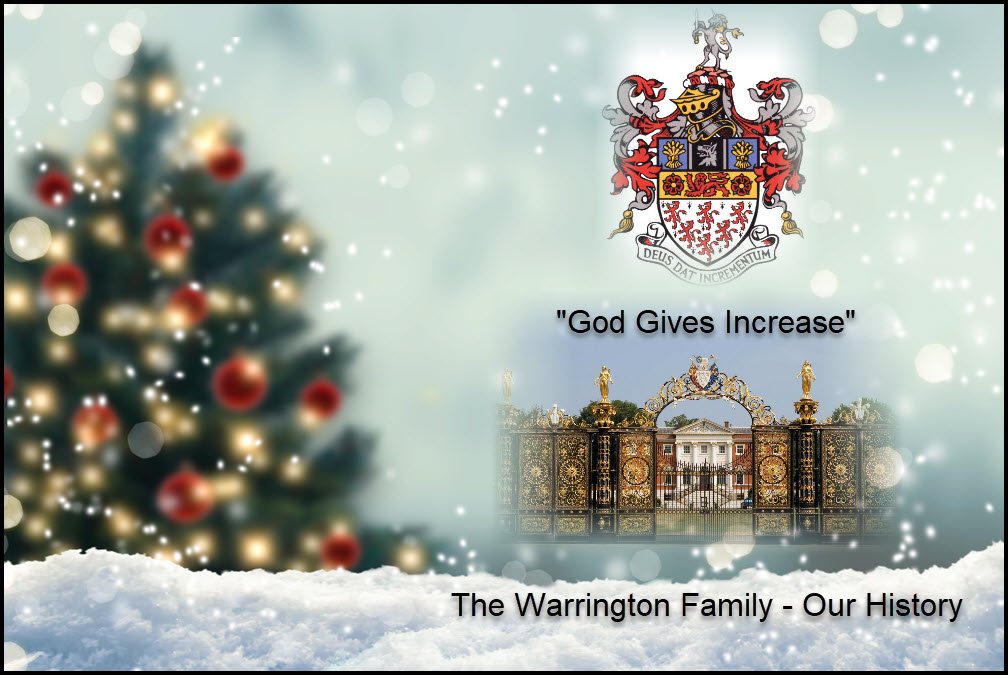
A cherished emblem of our roots, the Warrington coat of arms—often referred to colloquially as a “family crest”—features
elements associated with the historic lords of Warrington town. While heraldry in England is traditionally granted to
individuals rather than surnames broadly, our habitational name and geographic proximity allow us to draw inspiration
from these arms as a symbolic connection.
Arms often associated with Warrington are described as:
Ermine, six lioncels rampant gules (arranged three, two, and one), within a bordure azure charged with eight covered
cups or.
Is there a direct historical record connecting our specific family line to these arms? Our known ancestors from
William Warrington Sr. (b. 1688) onward were primarily yeomen farmers and laborers in Staffordshire and Cheshire rather
than documented armigerous nobles. Still, with roots in villages near Warrington town—and the habitational nature of
the name—this heraldry can be held as a meaningful symbol: strength (lions) and service (cups) echo the themes of our
family’s resilience, migration, and public contribution.
Generations of Strength
Below is a structured genealogy, starting from our earliest confirmed English ancestors and extending to the present
day. Dates are listed as confirmed or approximate where records are sparse.
Chapman and Yardley Lines – Creativity and Transatlantic Ties
Through Patricia A. Warrington (née Chapman), the maternal side adds a creative thread and additional immigrant stories
that parallel the Warrington journey—England to America, fields to cities, tradition to opportunity.
Achievements and Migrations
Our family’s saga is one of transformation. From William Sr.’s humble Staffordshire fields to Joseph’s Cheshire farms,
we adapted to change. The 19th-century shift to Lancashire mirrored England’s industrial boom, while William
Bracegirdle’s emigration to America embodied courage—leaving familiar lands for Nebraska’s prairies and Colorado’s
opportunities.
Wayne Sr.’s work in Washington, D.C. and broader public service reflects the Warrington commitment to community.
Patricia’s advocacy for children echoes our enduring care for others. The Chapman–Yardley side adds a creative spark,
and the immigrant tales of Horace and George echo the same themes: bold choices, hard work, and building something that
lasts.
In a world of rapid change, our history teaches that with roots in strength—like the weir of Warrington—we can flow
forward.
To my grandchildren and beyond: You are the heirs to centuries of grit and grace. Explore Gawsworth’s churches, walk
Warrington’s bridges, or serve your communities as Wayne Sr. did. Let this report be a starting point—dive into
archives, collect stories from living relatives, and preserve the photos and letters that bring names to life.
Our story isn’t finished; it’s yours to write. With pride and love,The Warrington Family Heritage
Origins of the Warrington Surname
The Warrington Family Crest
Our Warrington Family Tree
Early English Generations (17th–18th Century)
The earliest confirmed ancestor—likely a farmer or laborer—living through the reigns of Queen Anne and George I.
Likely involved in farming or cottage industries as families shifted with early industrialization. Children included
Thomas.
Married in 1777 at St. James Church, Gawsworth. The “X” may indicate a mark used in records. Children included John.
Married September 13, 1796 in Swettenham. Raised a large family during an era shaped by wars and rural change.
Children included Joseph.
Migration and Growth in England (19th Century)
Relocated toward Lancashire during Victorian industrial shifts.
Married October 31, 1852 in Halifax, Yorkshire. Children included William Bracegirdle.
Emigrated to the USA in the late 19th century, beginning our American chapter.
The American Warringtons (Late 19th–20th Century)
Midwest roots and resilience through the Great Depression.
Wayne Sr. served in leading state and federal administrative roles and contributed to veterans and consumer-related
public service. Patricia devoted herself to children’s programs and civic community support—compassion and duty in
action.
Preserving the story and raising a remarkable family—ensuring the legacy stays alive for future generations.
The Modern Generation (20th–21st Century)
Children: Fennec Warrington
Children: Daniel, David, Kaitlyn, Karis
Children: Evelyn, Everett
The Maternal Branches
Jay contributed as a Hollywood writer during the film industry’s golden era. Grace Emma supported family life through
California’s rapid growth from early film culture into the rise of television.
Representing another immigrant chapter and the long arc of American change from the 1800s into the Prohibition era.
A blend of English tradition and American innovation, witnessing Los Angeles grow from a small city into a modern
metropolis.
Generation Summary
Generation
Key Figure
Birth/Death
Location
Notable Notes
1
William Warrington Sr.
1688–1745
Staffordshire, England
Rural foundation
2
Joseph Warrington & Mary Harrop
1718–?
Staffordshire/Cheshire
Early industrial adaptation
3
Thomas “X” & Sarah Thornicroft
1752–1801
Gawsworth, Cheshire
Agrarian resilience
4
John Warrington & Mary Leah
1777–1837
Cheshire
Family expansion
5
Joseph Warrington & Sarah E. Goodall
~1802–1865
Cheshire/Lancashire
Urban migration
6
John B. G. Warrington
1831–1910
England
Pre-emigration drive
7
William Bracegirdle Warrington
1853–?
England/USA
Transatlantic pioneer
8
William B. Warrington
1888–1945
Nebraska, USA
Midwest settler
9
Wayne Sr. & Patricia
1923–1989 / 1925–2002
CO / DC / AZ
Public service & community support
10–12
Modern generations
1950s–present
USA
Family growth & future legacy
Stories of Inspiration
A Message for the Future
Wayne Barton Warrington Jr.
December 25, 2025
You can include links, multiple paragraphs, names, dates, stories, and anything else you’d like to preserve.